
I helped build a VA team.
I trained virtual assistants, sat in on their weekly meetings, and watched them land clients, grow their income, and build a VA career. I knew exactly what they did, how they worked, and what clients expected from them.
And I still didn’t think I was qualified to be one.
That’s the part nobody talks about — how you can be surrounded by something, understand it completely, and still convince yourself it’s not for you. That you’re not ready. That your skills aren’t professional enough. That someone, somewhere, is going to figure out you don’t really know what you’re doing.
If that sounds familiar, this is the article I wish I had read before I almost talked myself out of everything. Because yes — moms can become virtual assistants. Even shy ones. Even ones who don’t feel ready. Even ones starting with no portfolio, no confidence, and a rate of $4 an hour.
This is my story.
What I Was Doing Before I Became a VA
Before I started freelancing, I was working office-based at a digital marketing and VA agency in the Philippines. It was my first job right out of college — and like a lot of first jobs, the pay was low. But I stayed, because I was learning, and because I was one of the pioneer employees helping build the VA department from the ground up. That felt meaningful, even when the salary didn’t quite reflect it.
My main role was finding clients for the VAs and handling SEO — helping optimize the agency’s website, managing our online presence. When the VAs needed support, we were there. When there were questions, we figured them out together. I was in the weekly meetings. I understood the workflows. I knew how client relationships were built and maintained.
Finding clients was literally part of my job description. That would later turn out to be an advantage I didn’t fully appreciate at the time.
But here’s the thing — even with all of that experience, even after two-plus years working alongside VAs every single day, I still didn’t think what I had was sellable.
I had skills. I just didn’t believe they added up to something worth paying for.
The Doubt That Almost Stopped Me

Being an introvert doesn’t help when you’re trying to put yourself out there.
I’m shy. I get nervous in interviews. The idea of pitching myself to a stranger — someone who might say no, or worse, ask me something I couldn’t confidently answer — made my stomach turn.
I also worried about stability. A full-time office job felt safe. Freelancing felt like a gamble. What if I landed one client and then lost them? What if the work wasn’t consistent? What if I quit my stable job and it didn’t work out?
So I stayed on the sidelines. I helped other people build their VA careers. I found clients for the VAs I worked with. And I kept quietly telling myself I wasn’t ready yet.
What I know now that I didn’t know then: not ready is not a fact. It’s a feeling. And feelings, especially fear-based ones, are not reliable career advisors.
What Finally Made Me Jump
It was 2020. The pandemic had just turned everything upside down. I had a baby at home. And somewhere between the uncertainty of the world and the reality of what I wanted my life to look like, I got desperate enough that fear stopped being the loudest voice in the room.
I didn’t have a dramatic turning point. No mentor sat me down and said Charisse, you’re clearly qualified, just go. I just reached a point where I wanted more — for my family, for our finances, for a life that felt like mine. Financial freedom. Flexibility. Remote work that could fit around a baby and a household, not the other way around.
So I decided to try. Even though I was scared. Even though I wasn’t sure it would work.
I joined Facebook groups — the kind where small business owners and professionals post when they’re looking for help. I saw an opportunity. I messaged a potential client. No polished pitch. No portfolio. Just a genuine message about what I could do and how I could help her.
I was so lucky that she was friendly and said yes to me.
My First Rate Was $4 an Hour
I’ll just say it: when I became a virtual assistant, my first rate was $4 per hour.
I was undercharging and I knew it. But I also knew I needed proof — one client, one testimonial, one person who could say she showed up, she delivered, I’d recommend her.
I wasn’t confident enough to charge what I was probably worth. So I started at $4. Then slowly raised it to $5. Then $7 with other clients. Not a dramatic leap — just small, steady steps forward as my confidence caught up with my capability.
If you’re sitting on a number that feels embarrassingly low right now — start there if you have to. But have a plan to raise it. Because you will raise it, once you realize clients are willing to pay and that you’re actually delivering real value.
What I Offered — And How I Got More Clients Than I Expected
My first service was social media management — creating content, designing graphics in Canva, local SEO support. Not because it was my strongest skill. Honestly, it wasn’t. My Canva skills at the time were basic at best. I wasn’t a natural writer. Social media wasn’t even my main focus at the agency.
But I knew enough to help. And I worked hard to fill in the gaps.
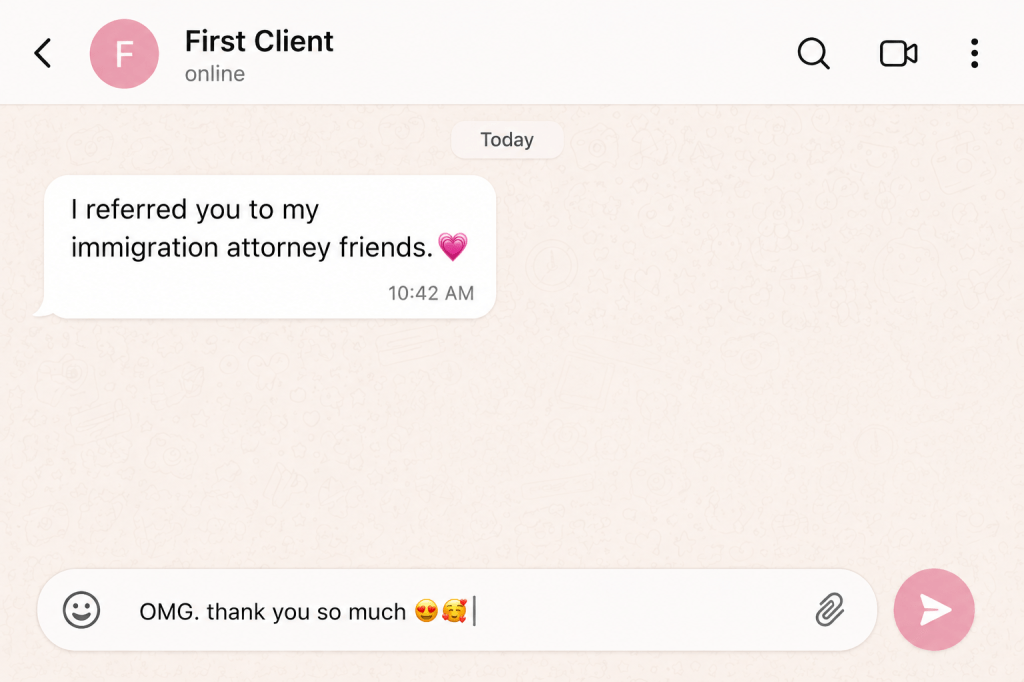
That first client connected me with others. Then those clients connected me with more. Most of my early clients came from referrals — word of mouth from that very first yes. Each one came through because the previous client trusted me enough to pass my name along.
That’s how I went from one client to six international clients — without a portfolio, without a website, without anything except genuine work and follow-through.
The seventh client was my former manager from the agency — she had since started her own business and asked me to come on as her Operations Manager, Project Manager, and Executive VA. That was six years ago. I’m still working with her today.
The Decision That Scared Me Most
Once I had a few clients, I had a choice to make.
I was juggling my agency job and my growing list of freelance clients. The work was building. The income was increasing. And I had a baby at home, a pandemic outside, and a dream that kept getting louder.
So I resigned.
It was one of the scariest decisions I’ve ever made. Stable salary. Health benefits. A team I knew. Gone. In exchange for something that felt uncertain, even if it was mine.
But I kept coming back to the same thought — I dreamed of a better life for my family. Financial freedom. A career that worked around my baby, not against her. A life I actually chose.
Freelancing gave me that. Not immediately. Not perfectly. But steadily, with every client I showed up for, every skill I improved, every time I pushed through the nerves and did the work anyway.
What the Agency Years Actually Gave Me
Here’s what I didn’t fully understand at the time: working at that agency wasn’t just a job. It was training.
I had learned how to find clients — because that was literally my role. I understood VA work from the inside because I had supported an entire team of them. I knew what clients expected, what communication should look like, and how to build relationships that last.
I just didn’t call it “VA experience” because I wasn’t the one holding the client title. But the skills were the same.
And the skills I felt unsure about — Canva, social media, content creation — those grew as I worked. The more clients I took on, the more I improved. That’s how it works. Confidence doesn’t come before the work. It comes from the work.
If you’ve spent time in any job — office-based, service work, teaching, anything — you have transferable skills. You’ve just been calling them something else. That’s the biggest lesson from my beginner virtual assistant journey: the skills were always there. The belief just had to catch up.
Where I Am Now
That $4/hour client in a Facebook group in 2020 was the beginning of everything.
Six international clients. One long-term local client who has become one of the most important professional relationships of my life. A career I built from home, around my family, starting with a skill set I almost talked myself out of offering.
I’m not the same VA I was in 2020. My digital marketing and creative skills are sharper. My confidence is real now, not performed. I’ve expanded into link building, blogging, Pinterest management, operations, executive support — work that I’m genuinely good at and that clients trust me with.
But none of that would exist if I hadn’t sent that first message. Scared. Unpolished. Without a portfolio. At $4 an hour.
What I Want You to Take From This
If you’re reading this and thinking your skills aren’t enough — I want you to sit with this for a moment.
You don’t need to be the best. You need to be good enough to help someone today, and willing to improve from there. The rest builds as you go.
Write down what you’ve done — every job, every task, every time someone relied on you and you delivered. That list is your starting point for becoming a virtual assistant, even if you have no formal experience and no idea where to begin.
Find one opportunity. Send one genuine message. Offer one service you can actually deliver today.
You don’t need the confidence first. I didn’t have it.
I just decided — even though I was scared, even though I wasn’t sure — that wanting a better life for my family was a good enough reason to try.
It was.
Read next: How to Become a Virtual Assistant with No Experience (Beginner Mom’s Guide) — the practical step-by-step guide if you’re ready to start your own VA journey.


Leave a comment